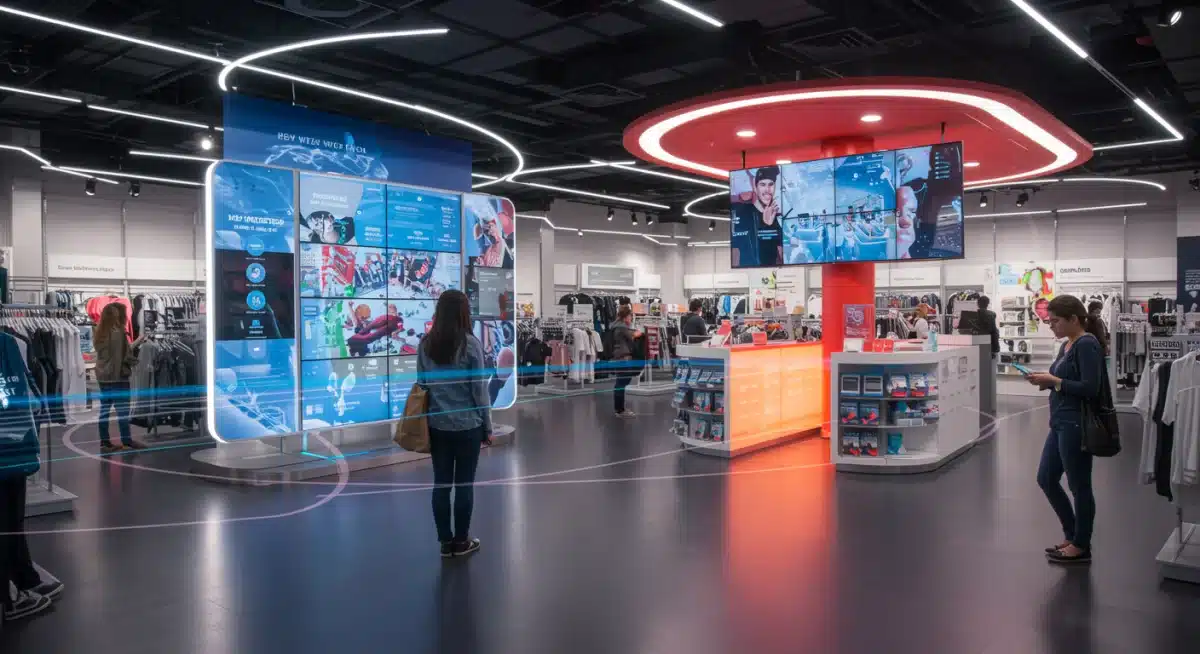
The future of POS systems for US retailers in 2025 will be defined by advanced technological integrations, focusing on AI-driven insights, seamless mobile experiences, and unified omnichannel operations to redefine customer interaction and operational efficiency.
As the retail landscape continues its rapid evolution, understanding The Future of POS Systems: 5 Key Tech Upgrades for US Retailers in 2025 is not just beneficial, but essential. The point-of-sale has transcended its traditional role, becoming a strategic hub for data, customer engagement, and operational efficiency. Are you ready to discover the innovations set to redefine retail?
The Rise of AI and Machine Learning in POS
Artificial Intelligence (AI) and Machine Learning (ML) are not just buzzwords; they are transformative forces reshaping the capabilities of point-of-sale systems. These technologies enable POS systems to move beyond simple transaction processing, offering intelligent insights and enhanced operational prowess.
For US retailers, integrating AI into their POS means unlocking a new level of predictive analytics. This allows for more accurate inventory management, personalized customer recommendations, and optimized staffing schedules. The ability of AI to process vast amounts of data quickly provides a competitive edge in a fast-paced market.
Predictive Analytics for Inventory Management
AI-powered POS systems can analyze historical sales data, seasonal trends, and even external factors like weather patterns or local events to forecast demand with remarkable accuracy. This minimizes overstocking and understocking, reducing waste and maximizing sales opportunities.
- Demand Forecasting: AI algorithms predict future sales based on past performance and external variables.
- Automated Reordering: Systems can automatically trigger reorder notifications or even place orders when stock levels hit predefined thresholds.
- Waste Reduction: By optimizing inventory, retailers significantly cut down on spoiled or unsold goods.
Personalized Customer Experiences
Machine learning allows POS systems to learn individual customer preferences based on past purchases, browsing history, and loyalty program data. This enables staff to offer highly tailored product suggestions and promotions at the checkout, enhancing the shopping experience and driving repeat business.
Imagine a customer checking out, and the POS system suggests an accessory perfectly complementing their purchase, based on their previous buying habits. This level of personalization builds stronger customer relationships and increases average transaction values.
The integration of AI and ML into POS systems is fundamentally shifting how retailers operate. It’s about making smarter decisions faster, improving efficiency, and ultimately, delivering a superior customer journey. Retailers who embrace these advancements will find themselves well-positioned for the future.
Seamless Mobile and Contactless Payment Integration
The convenience of mobile and contactless payments has irrevocably changed consumer expectations. In 2025, POS systems must offer seamless integration of these payment methods to cater to a tech-savvy customer base and ensure quick, secure transactions.
US consumers increasingly prefer tapping their cards or phones over traditional swiping. Retailers who provide these options not only meet customer demand but also benefit from faster checkout times and reduced hardware maintenance associated with older payment terminals.
Benefits of Mobile POS (mPOS)
Mobile POS solutions empower sales associates to conduct transactions anywhere in the store, breaking free from fixed checkout counters. This flexibility is invaluable in busy retail environments, allowing for queue busting and an enhanced, personalized shopping experience.
- Increased Efficiency: Transactions can be completed on the sales floor, reducing wait times.
- Enhanced Customer Service: Staff can assist customers, look up inventory, and process sales without leaving their side.
- Flexibility: Ideal for pop-up shops, outdoor events, or seasonal sales where traditional POS setups are impractical.
The Rise of Contactless Transactions
Contactless payments, facilitated by NFC (Near Field Communication) technology, are becoming the standard. This includes payment methods like Apple Pay, Google Pay, and contactless credit/debit cards. Modern POS systems are built to fully support these options, ensuring security and speed.
The quick and secure nature of contactless payments appeals to both consumers and retailers. It minimizes physical contact, which has become an important consideration, and speeds up the transaction process, allowing more customers to be served efficiently.

Embracing mobile and contactless payment integration is no longer a luxury but a necessity for US retailers. It streamlines operations, improves customer satisfaction, and aligns with the evolving digital payment landscape, setting the stage for future growth and innovation.
Omnichannel Integration and Unified Commerce
True omnichannel integration goes beyond simply having multiple sales channels; it means creating a unified and consistent customer experience across all touchpoints. In 2025, POS systems will be central to achieving this unified commerce vision for US retailers.
A unified commerce platform ensures that customer data, inventory, and sales information are synchronized in real-time across online, in-store, and mobile channels. This eliminates silos and allows retailers to provide a truly seamless shopping journey, regardless of how or where a customer chooses to interact with the brand.
Connecting Online and Offline Data
Modern POS systems act as the bridge between a retailer’s physical and digital presence. They capture in-store purchase data and merge it with online browsing and buying patterns, creating a comprehensive view of each customer. This unified data profile is crucial for effective personalization and marketing.
For example, a customer who browses an item online and then purchases it in-store will have their journey accurately tracked. This allows for targeted follow-up communications and loyalty rewards that acknowledge their complete interaction history.
- Centralized Customer Profiles: All customer interactions, online and offline, are consolidated.
- Real-time Inventory Visibility: Customers can check in-store stock online, or store associates can view online inventory.
- Seamless Returns and Exchanges: Purchases made online can be returned in-store effortlessly, and vice versa.
The move towards unified commerce with POS at its core is essential for US retailers to meet modern consumer expectations. It delivers convenience, consistency, and a highly personalized experience that fosters loyalty and drives sales in an increasingly competitive market.
Enhanced Security and Fraud Prevention
With the increasing sophistication of cyber threats, enhanced security and robust fraud prevention mechanisms are paramount for POS systems. US retailers in 2025 will require POS solutions that offer multi-layered protection for sensitive customer data and transactions.
Data breaches can be devastating for businesses, leading to significant financial losses, reputational damage, and erosion of customer trust. Therefore, modern POS systems are incorporating advanced encryption, tokenization, and biometric authentication to safeguard every transaction.
Advanced Encryption and Tokenization
Encryption scrambles transaction data, making it unreadable to unauthorized parties, while tokenization replaces sensitive payment card information with a unique, non-sensitive identifier (a token). If a breach occurs, only these tokens are exposed, not actual card numbers.
These technologies work in tandem to create a secure environment for processing payments. They are crucial for compliance with industry standards like PCI DSS (Payment Card Industry Data Security Standard) and for protecting both the retailer and their customers.
Biometric Authentication and AI-Powered Fraud Detection
Biometric authentication, such as fingerprint or facial recognition, is gaining traction as a highly secure method for authorizing transactions or accessing sensitive POS functions. It adds an extra layer of security that is difficult to compromise.
- Fingerprint Scanners: Used for employee login or high-value transactions.
- Facial Recognition: Can verify employee identity or even detect suspicious behavior.
- AI Anomaly Detection: Machine learning algorithms analyze transaction patterns in real-time to identify and flag potentially fraudulent activities before they can cause damage.
Investing in POS systems with enhanced security and fraud prevention capabilities is a non-negotiable for US retailers. It protects financial assets, preserves customer trust, and ensures compliance in an era where data security is a top consumer concern.
Cloud-Based POS and Scalability
The shift to cloud-based POS systems is one of the most significant trends for US retailers, offering unparalleled flexibility, scalability, and cost-effectiveness. In 2025, cloud POS will be the foundation for agile retail operations.
Unlike traditional on-premise systems, cloud POS stores data remotely on secure servers, accessible from any internet-enabled device. This means retailers can manage their business from anywhere, easily scale operations up or down, and receive automatic software updates without manual intervention.
Benefits of Cloud-Based Architecture
Cloud POS eliminates the need for expensive hardware investments and maintenance, reducing operational costs. It also provides real-time data synchronization across multiple locations, offering a unified view of sales and inventory, which is critical for multi-store retailers.
The ability to access business data on the go empowers owners and managers to make informed decisions quickly, whether they are in the store, at home, or traveling. This level of accessibility was previously unimaginable with traditional systems.
- Cost Efficiency: Lower upfront investment and reduced maintenance costs.
- Remote Accessibility: Manage your business from anywhere, on any device.
- Automatic Updates: Software is always up-to-date with the latest features and security patches.
- Scalability: Easily add new terminals or locations as your business grows without major infrastructure changes.
Cloud-based POS systems offer the agility and responsiveness that modern US retailers need to thrive. Their inherent scalability and ease of management make them an ideal choice for businesses looking to adapt quickly to market changes and expand efficiently.
The Role of IoT and Smart Devices
The Internet of Things (IoT) is increasingly converging with POS systems, transforming the retail environment into a network of interconnected smart devices. For US retailers in 2025, integrating IoT will unlock new levels of operational intelligence and customer engagement.
IoT in retail encompasses everything from smart shelves that monitor inventory levels to connected sensors that track customer foot traffic and environmental conditions. When linked with POS, these devices provide a richer, more granular data set that enhances decision-making and automates routine tasks.
Smart Shelves and Automated Inventory
Smart shelves equipped with weight sensors or RFID readers can automatically detect when products are running low and communicate this information directly to the POS system. This triggers automated reorder processes or alerts staff to restock, ensuring shelves are always full.
This automation significantly reduces the manual effort involved in inventory checks, minimizes out-of-stock situations, and improves overall stock accuracy. It also frees up staff to focus on customer service rather than inventory management.
Customer Tracking and Personalized Engagement
IoT sensors can anonymously track customer movement patterns within a store, providing valuable insights into popular areas, dwell times, and traffic flow. This data, when analyzed by the POS system, helps optimize store layouts and product placements.
- Foot Traffic Analysis: Understand which areas of the store attract the most attention.
- Heat Maps: Visualize customer movement to optimize product placement and promotions.
- Personalized Offers: Integrate with customer loyalty programs to send targeted promotions as customers browse specific areas.
The synergy between IoT and POS systems is creating intelligent retail spaces. For US retailers, leveraging these smart devices means gaining deeper insights into store performance and customer behavior, leading to more efficient operations and highly personalized shopping experiences.
| Key Upgrade | Brief Description |
|---|---|
| AI & Machine Learning | Enables predictive analytics for inventory, personalized offers, and optimized operations. |
| Mobile & Contactless Payments | Offers flexible, fast, and secure transaction options for modern consumers. |
| Omnichannel Integration | Unifies online and offline data for a consistent customer journey and real-time insights. |
| Cloud-Based POS | Provides scalability, remote management, and reduced costs for agile retail operations. |
Frequently Asked Questions About Future POS Systems
AI will provide small retailers with sophisticated demand forecasting, optimizing inventory without large teams. It also enables personalized customer interactions, helping build loyalty and compete with larger chains by efficiently targeting promotions and product recommendations.
Crucial security features include end-to-end encryption, tokenization for payment data, and AI-powered fraud detection. Biometric authentication for staff access is also becoming vital to protect sensitive information and maintain compliance with data security standards like PCI DSS.
Omnichannel integration significantly enhances customer experience by providing a consistent and seamless journey across all touchpoints. Customers can browse online, purchase in-store, or return items interchangeably, fostering convenience and a personalized shopping experience that builds brand loyalty.
Cloud-based POS systems are crucial for scalability because they allow retailers to easily add new terminals, locations, or features without significant hardware investments. This flexibility helps businesses adapt quickly to growth or market changes, ensuring operations remain agile and efficient.
IoT will connect smart devices like shelves and sensors to POS systems, providing real-time data on inventory and customer behavior. This integration will enable automated restocking, optimize store layouts, and facilitate highly personalized customer engagement through data-driven insights.
Conclusion
The future of POS systems in 2025 for US retailers is one of unprecedented innovation and integration. From the analytical power of AI and machine learning to the seamless convenience of mobile payments and the unified experience of omnichannel commerce, these technological upgrades are more than just enhancements; they are foundational shifts. Retailers who proactively adopt these advancements will not only streamline their operations and bolster security but also cultivate deeper customer relationships, ensuring their relevance and competitiveness in a dynamic market. Embracing these key tech upgrades is imperative for sustained growth and success in the evolving retail landscape.