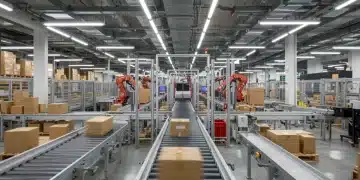
Automated Warehousing: 25% Faster Fulfillment by 2025

Automated warehousing is projected to enhance fulfillment speeds by 25% by 2025, providing a critical competitive edge for businesses seeking to revolutionize their logistics and satisfy dynamic market demands.
Imagine a world where your online orders arrive not just quickly, but with unprecedented speed and accuracy. This vision is rapidly becoming a reality, driven by the transformative power of automated warehousing fulfillment. The promise of achieving 25% faster fulfillment by 2025 isn’t just an ambitious goal; it’s a strategic imperative for businesses navigating the evolving landscape of global commerce.
The imperative for speed in modern logistics
In today’s hyper-competitive e-commerce environment, speed is no longer just a luxury; it’s a fundamental expectation. Consumers demand faster delivery, and businesses that fail to meet these expectations risk losing market share. This relentless pressure is forcing companies to re-evaluate their entire supply chain, with a particular focus on the warehouse, often the bottleneck in the fulfillment process.
The rise of same-day and next-day delivery promises has pushed traditional warehousing models to their limits. Manual processes, prone to human error and limited by physical constraints, simply cannot keep pace. This creates a compelling case for automation, not just as an efficiency booster, but as a critical survival tool in the modern retail landscape.
Evolving consumer expectations
Consumer behavior has shifted dramatically. What was once considered fast delivery is now the baseline. Expectations continue to escalate, making it essential for retailers to adapt. This means:
- Instant gratification: Shoppers expect their purchases almost immediately.
- Transparency: Real-time tracking and accurate delivery estimates are non-negotiable.
- Flexibility: Options for pickup, varied delivery windows, and easy returns are crucial.
These demands directly impact warehouse operations, requiring a level of agility and precision that only advanced automation can provide. The ability to quickly process, pick, pack, and ship orders is paramount to customer satisfaction and loyalty.
The drive for faster fulfillment isn’t just about meeting expectations; it’s about exceeding them to gain a competitive edge. Businesses that can consistently deliver faster and more reliably will stand out in a crowded market. This pursuit of speed and efficiency forms the bedrock of modern logistics strategy, making automated warehousing a central pillar of future success.
Understanding automated warehousing technologies
Automated warehousing encompasses a broad spectrum of technologies designed to streamline and accelerate warehouse operations. These technologies work in concert to reduce manual labor, minimize errors, and optimize space utilization, ultimately leading to significant improvements in fulfillment speed. From robotic systems to advanced software, the tools available are transforming how goods are managed and moved.
The integration of these various technologies creates a synergistic effect, where the whole is greater than the sum of its parts. A truly automated warehouse is a complex ecosystem where data flows seamlessly, guiding machines and processes to achieve peak performance. This integrated approach is key to unlocking the full potential of automation in logistics.
Key automation components
Several core technologies form the backbone of modern automated warehouses:
- Automated Guided Vehicles (AGVs) and Autonomous Mobile Robots (AMRs): These intelligent robots transport goods within the warehouse, reducing the need for human operators and increasing throughput.
- Automated Storage and Retrieval Systems (AS/RS): AS/RS solutions, including cranes and shuttles, automatically store and retrieve items, optimizing vertical space and accelerating picking processes.
- Robotic Picking Systems: Advanced robotic arms equipped with vision systems can identify, pick, and place individual items with high precision and speed, often surpassing human capabilities for repetitive tasks.
- Conveyor and Sortation Systems: These systems efficiently move products between different areas of the warehouse and sort them for shipping, minimizing manual handling and bottlenecks.
Beyond hardware, sophisticated software plays a crucial role. Warehouse Management Systems (WMS) and Warehouse Execution Systems (WES) orchestrate these automated components, providing real-time visibility, optimizing workflows, and managing inventory with unparalleled accuracy. These software platforms are the brains behind the brawn, ensuring that every automated task is performed efficiently and effectively.


The path to 25% faster fulfillment by 2025
Achieving a 25% increase in fulfillment speed by 2025 is an ambitious yet attainable goal for many businesses embracing automated warehousing. This acceleration isn’t just about implementing new machines; it involves a comprehensive strategy that touches on process optimization, data analytics, and strategic investment. The journey requires careful planning and a phased approach to ensure seamless integration and maximum impact.
The focus must be on identifying pain points in current fulfillment processes and strategically deploying automation to address them. This could mean automating specific tasks, entire workflows, or even redesigning the entire warehouse layout to maximize the efficiency of automated systems. The key is to leverage technology where it can deliver the most significant gains in speed and accuracy.
Strategic implementation steps
To realize this significant leap in fulfillment speed, businesses should consider:
- Detailed process analysis: Identify bottlenecks and inefficiencies in current manual or semi-automated operations.
- Phased automation rollout: Begin with smaller, less complex automation projects to gain experience and demonstrate ROI before scaling up. This minimizes disruption and allows for continuous learning.
- Integration with existing systems: Ensure new automated systems seamlessly integrate with existing WMS, ERP, and e-commerce platforms for end-to-end visibility and control.
- Workforce training and adaptation: Prepare the existing workforce for new roles involving monitoring, maintenance, and oversight of automated systems.
Beyond these steps, continuous monitoring and optimization are crucial. Data analytics from automated systems can provide invaluable insights into performance, allowing for ongoing adjustments and improvements. This iterative process ensures that the automated warehouse continues to evolve and deliver increasing levels of efficiency and speed, pushing towards and potentially exceeding the 25% fulfillment acceleration target.
Benefits beyond speed: accuracy, cost, and safety
While the primary driver for adopting automated warehousing is often increased fulfillment speed, the benefits extend far beyond just faster deliveries. Automation brings a host of advantages that contribute to overall operational excellence, including enhanced accuracy, reduced operational costs, and improved safety for warehouse personnel. These secondary benefits further solidify the business case for investing in automation.
The synergistic effect of these benefits creates a more resilient, efficient, and profitable supply chain. Businesses that embrace automation not only get faster, but they also become smarter, leaner, and safer. This holistic improvement is what makes automated warehousing a truly transformative solution for modern logistics challenges.
Multifaceted advantages of automation
The advantages of automated warehousing are numerous and impactful:
- Enhanced Accuracy: Automated systems significantly reduce human error in picking, packing, and shipping, leading to fewer mis-shipments, returns, and improved customer satisfaction.
- Reduced Operational Costs: While initial investment can be substantial, automation leads to long-term savings through reduced labor costs, optimized space utilization, lower energy consumption, and minimized product damage.
- Improved Worker Safety: Robots can handle heavy lifting, repetitive tasks, and operate in hazardous environments, reducing the risk of injuries to human workers.
- Scalability and Flexibility: Automated systems can be scaled up or down to meet fluctuating demand, offering greater flexibility during peak seasons or periods of rapid growth.
- Better Inventory Management: Real-time data from automated systems provides precise inventory visibility, preventing stockouts and overstocking.
These benefits collectively contribute to a stronger competitive position. Improved accuracy builds customer trust, cost reductions boost profitability, and enhanced safety fosters a better work environment. The strategic adoption of automated warehousing is therefore not just a technological upgrade but a comprehensive business improvement strategy.
Challenges and considerations for adoption
Despite the compelling benefits, the journey to fully automated warehousing is not without its challenges. Businesses considering this transformation must carefully evaluate various factors, from the initial capital investment to the complexities of integration and the need for a skilled workforce. Addressing these considerations proactively is crucial for a successful implementation and realizing the promised gains in fulfillment speed.
The transition requires a strategic mindset, moving beyond a simple technology purchase to a holistic change management process. Understanding and mitigating potential hurdles will ensure that the investment in automation yields the desired returns and positions the business for long-term success in a rapidly evolving market.
Navigating the automation landscape
Key challenges and considerations include:
- High upfront investment: Automated systems can be expensive, requiring significant capital outlay. A thorough ROI analysis and careful budgeting are essential.
- Integration complexity: Integrating new automation technologies with existing IT infrastructure and legacy systems can be challenging and time-consuming.
- Workforce retraining: While automation reduces manual labor, it creates a need for skilled technicians to operate, maintain, and troubleshoot the new systems.
- System downtime and maintenance: Automated systems require regular maintenance, and any downtime can significantly impact operations. Robust maintenance protocols and contingency plans are vital.
- Scalability and future-proofing: Choosing systems that can adapt to future growth and technological advancements is important to avoid obsolescence.
Addressing these challenges requires a clear vision, strong leadership, and a commitment to continuous improvement. Partnerships with experienced automation providers, comprehensive planning, and a focus on change management within the organization can help overcome these hurdles, paving the way for a smooth and successful transition to automated warehousing.
The future landscape of automated fulfillment
Looking beyond 2025, the future of automated fulfillment promises even more sophisticated and integrated systems. The rapid evolution of artificial intelligence (AI), machine learning (ML), and advanced robotics will continue to push the boundaries of what’s possible in warehousing. We can anticipate warehouses that are not just automated, but truly intelligent, capable of self-optimization and predictive analysis, further enhancing speed and efficiency.
The vision is clear: warehouses will transform from static storage facilities into dynamic, intelligent hubs that are central to the entire supply chain ecosystem. This ongoing evolution will redefine logistics, setting new benchmarks for speed, accuracy, and responsiveness, and ultimately shaping the future of commerce.
Emerging trends and innovations
Several trends are set to shape the next generation of automated fulfillment:
- AI-powered optimization: AI and ML will enable predictive analytics for demand forecasting, dynamic slotting, and optimized routing for AGVs and robots, leading to even greater efficiencies.
- Collaborative robots (cobots): Cobots will work alongside human employees, combining the strengths of both to perform complex tasks more efficiently and safely.
- Drone technology: Drones could be used for inventory counts, surveillance, and even light-item delivery within large warehouses.
- Edge computing: Processing data closer to the source will enable faster decision-making and real-time adjustments for automated systems.
- Sustainable automation: Future systems will focus on energy efficiency and sustainable materials, aligning with broader environmental goals.
These innovations will not only contribute to achieving faster fulfillment but also create more resilient and adaptable supply chains. The intelligent warehouse of the future will be a highly responsive entity, capable of navigating unforeseen challenges and continuously optimizing its operations to meet the ever-increasing demands of the market. The continuous development in automated warehousing will ensure that the goal of 25% faster fulfillment by 2025 is just one step in a much larger journey towards logistical excellence.
| Key Aspect | Description |
|---|---|
| Fulfillment Speed Goal | Achieving 25% faster fulfillment by 2025, driven by automation to meet market demands. |
| Core Technologies | AGVs, AMRs, AS/RS, robotic picking, and advanced WMS/WES for optimized operations. |
| Key Benefits | Improved accuracy, reduced costs, enhanced safety, scalability, and better inventory control. |
| Future Outlook | Integration of AI/ML, cobots, and drones for intelligent, self-optimizing warehouse operations. |
Frequently Asked Questions about Automated Warehousing
Automated warehousing involves using advanced technologies like robots, automated storage systems, and intelligent software to streamline and accelerate various warehouse operations, from receiving and storage to picking, packing, and shipping.
Automation reduces manual labor, minimizes errors, optimizes space, and enables continuous, faster processing of orders. By eliminating bottlenecks and enhancing precision, businesses can significantly cut down on order cycle times and achieve substantial speed improvements.
Key technologies include Automated Guided Vehicles (AGVs), Autonomous Mobile Robots (AMRs), Automated Storage and Retrieval Systems (AS/RS), robotic picking systems, and sophisticated Warehouse Management Systems (WMS) and Warehouse Execution Systems (WES).
In addition to faster fulfillment, automation provides enhanced accuracy, leading to fewer errors and returns, reduced operational costs through optimized labor and space, improved worker safety by minimizing hazardous tasks, and greater scalability to handle demand fluctuations.
Challenges include high upfront investment costs, complex integration with existing systems, the need for workforce retraining, potential system downtime, and ensuring scalability for future growth. Careful planning and strategic partnerships are essential to overcome these hurdles.
Conclusion
The pursuit of 25% faster fulfillment by 2025 through automated warehousing is not merely a trend but a fundamental shift in how businesses approach logistics and customer satisfaction. By strategically investing in and integrating advanced automation technologies, companies can not only meet but exceed the escalating demands of modern commerce. The benefits, extending from unparalleled speed and accuracy to significant cost savings and improved safety, underscore the transformative power of automation, cementing its role as an indispensable component of future-proof supply chains.