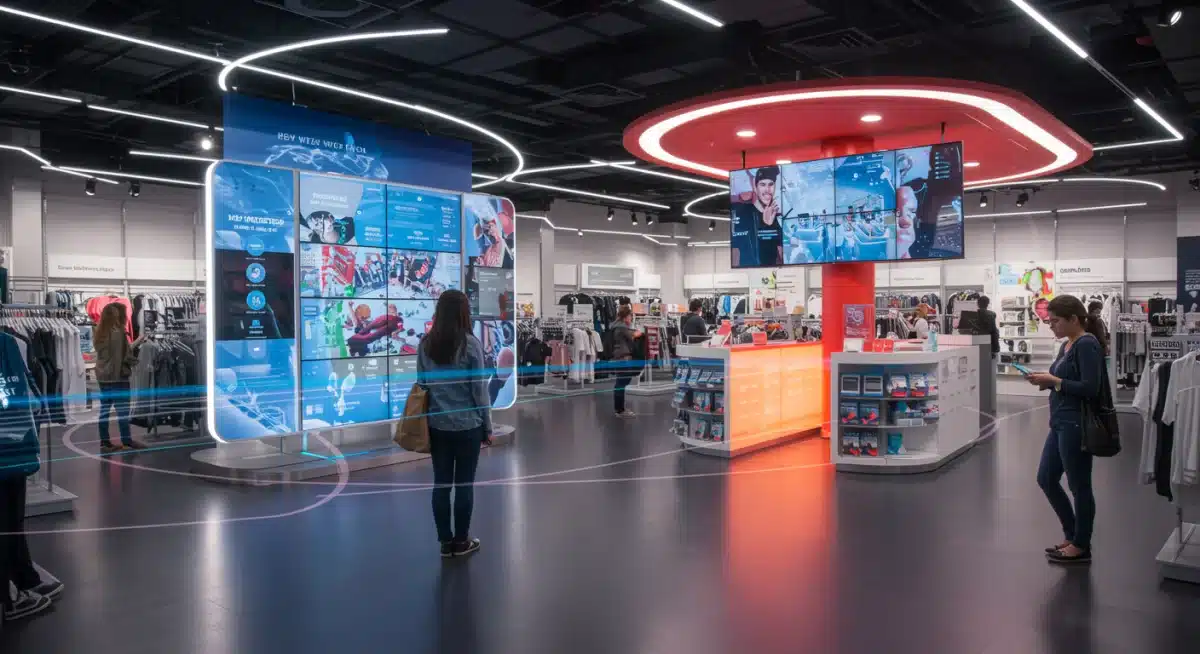
Augmented reality in retail is rapidly transforming the online shopping landscape, projected to increase online conversions for US brands by 20% by 2025 through immersive product visualization and enhanced customer engagement.
The retail industry is in a constant state of evolution, and the next significant leap forward is being powered by augmented reality (AR). For US brands, the integration of augmented reality in retail: driving a 20% increase in online conversions for US brands by 2025 is not just a futuristic vision, but a tangible goal that is already shaping consumer behavior and boosting sales. This technology offers a unique bridge between the digital and physical worlds, allowing customers to interact with products in unprecedented ways before making a purchase.
The transformative power of AR in retail
Augmented reality is revolutionizing how consumers interact with products online. By overlaying digital information onto the real world, AR provides an immersive and highly personalized shopping experience that traditional e-commerce platforms struggle to match. This technology allows customers to visualize products in their own environment, try on clothing virtually, or even test out different furniture pieces in their homes.
The impact on online conversions is profound. When customers can experience a product more intimately, their confidence in a purchase grows significantly. This reduction in uncertainty directly translates to higher conversion rates and fewer returns, creating a win-win situation for both consumers and retailers.
Enhancing product visualization
One of the primary benefits of AR in retail is its ability to provide superior product visualization. Static images and even 360-degree videos often fall short in conveying a product’s true scale, texture, or fit. AR bridges this gap by allowing customers to place virtual models of products into their physical space.
- Virtual Try-On: Enables customers to virtually try on clothes, glasses, or makeup, seeing how items look on them without needing to physically wear them. This is particularly impactful for fashion and beauty brands.
- Spatial Configuration: Allows consumers to place virtual furniture, appliances, or decor items in their homes, ensuring a perfect fit and aesthetic before purchase.
- 3D Product Previews: Offers interactive 3D models of products that customers can manipulate, zoom in on, and inspect from every angle, revealing details not visible in standard photos.
By offering these rich, interactive experiences, AR helps customers make more informed decisions, reducing the likelihood of buyer’s remorse and increasing satisfaction.
Boosting customer engagement
Beyond visualization, AR fosters deeper customer engagement. The novelty and interactivity of AR experiences capture attention and create a memorable shopping journey. This engagement can lead to increased time spent on a brand’s website or app, stronger brand loyalty, and ultimately, higher conversion rates.
The gamification aspect of some AR applications also plays a role, making shopping feel less like a chore and more like an enjoyable activity. Brands can leverage AR to create unique marketing campaigns, virtual showrooms, and interactive product demonstrations that stand out from the competition.
In essence, AR transforms passive browsing into an active, engaging exploration, directly contributing to the projected 20% increase in online conversions for US brands by 2025.
The current landscape of AR adoption in US retail
While still emerging, AR adoption among US retailers is accelerating rapidly. Early adopters are already seeing significant returns on investment, prompting more brands to explore this technology. The widespread availability of AR-capable smartphones and tablets has lowered the barrier to entry for both businesses and consumers.
Major players in various retail sectors, from furniture to fashion and cosmetics, have successfully integrated AR into their online strategies. These pioneering efforts serve as compelling case studies, demonstrating the tangible benefits of AR in enhancing the online shopping experience and driving sales growth.
Leading brands and their AR implementations
Several prominent US brands have embraced augmented reality, setting benchmarks for others to follow. These implementations often focus on solving specific customer pain points related to online shopping.
- IKEA Place: Allows users to virtually place furniture in their homes, addressing a critical challenge for online furniture shoppers regarding scale and fit.
- Sephora Virtual Artist: Enables customers to try on various makeup products virtually, helping them visualize different looks without physical application.
- Warby Parker’s Virtual Try-On: Offers a seamless way for customers to see how different frames look on their face, simplifying the online eyewear purchase.
These examples highlight the versatility of AR and its applicability across diverse product categories, all aimed at reducing uncertainty and friction in the online buying process. The success of these initiatives underscores the potential for a broader impact across the US retail sector.
Technological advancements and accessibility
The rapid advancement in smartphone camera technology, alongside robust AR development platforms like Apple’s ARKit and Google’s ARCore, has made AR more accessible than ever. Developers can now create sophisticated AR experiences with relative ease, integrating them directly into existing mobile applications or web browsers.
Furthermore, improvements in networking infrastructure and processing power mean that AR applications run smoothly and reliably, providing a consistent and positive user experience. This technological maturity is a crucial factor in the projected growth of AR in retail and its impact on online conversions.

The increasing accessibility and sophistication of AR tools mean that even smaller brands can now consider implementing AR solutions, leveling the playing field and fostering innovation in retail across the industry.
Overcoming challenges and maximizing AR’s potential
Despite its immense potential, the widespread adoption of AR in retail faces certain challenges. These include the need for high-quality 3D models, ensuring a seamless user experience, and educating consumers on how to best utilize AR features. Addressing these hurdles is crucial for maximizing AR’s impact on online conversions.
Retailers must invest in creating accurate and visually appealing 3D assets for their products. A poor-quality AR experience can be detrimental, undermining trust rather than building it. Furthermore, integrating AR seamlessly into the existing online shopping journey is paramount, ensuring it enhances, rather than complicates, the customer’s path to purchase.
Data and analytics in AR implementation
Leveraging data and analytics is key to optimizing AR experiences. Retailers can track how customers interact with AR features, identifying what works well and what needs improvement. This data-driven approach allows for continuous refinement of AR applications, ensuring they effectively contribute to conversion goals.
- User Engagement Metrics: Tracking the duration of AR sessions, number of interactions, and specific features used can provide insights into customer preferences.
- Conversion Funnel Analysis: Analyzing how AR influences different stages of the purchase funnel can help identify direct impacts on conversion rates.
- Feedback Mechanisms: Incorporating user feedback directly into AR apps allows for rapid iteration and improvement based on real-world customer experiences.
By understanding user behavior within AR environments, brands can tailor their offerings to better meet customer needs and drive the desired increase in online conversions.
The importance of user experience (UX)
A positive user experience is fundamental to the success of any AR implementation. The interface should be intuitive, the AR models should load quickly and accurately, and the overall interaction should feel natural and effortless. Complex or glitchy AR experiences will deter users and negate the potential benefits.
Investing in robust testing and user research is essential to ensure that AR features are not only functional but also enjoyable and easy to use. A well-designed AR experience can significantly enhance customer satisfaction and contribute directly to higher conversion rates, solidifying the role of augmented reality in retail: driving a 20% increase in online conversions for US brands by 2025.
Future trends and the continued evolution of AR in retail
The journey of augmented reality in retail is far from over; it’s continuously evolving with new technologies and innovative applications on the horizon. The future promises even more immersive and integrated AR experiences, further blurring the lines between online and offline shopping. These advancements will continue to fuel the growth in online conversions for US brands.
Expect to see more sophisticated AR hardware, such as smart glasses, becoming mainstream, offering hands-free and even more integrated AR experiences. Furthermore, the convergence of AR with artificial intelligence (AI) will lead to highly personalized shopping recommendations and dynamic product visualizations that adapt to individual customer preferences.
AR and AI synergy
The combination of augmented reality and artificial intelligence holds immense potential for retail. AI can analyze vast amounts of customer data to provide personalized AR experiences, recommending products that are not only aesthetically pleasing but also perfectly suited to the customer’s needs and context.
- Personalized Recommendations: AI algorithms can suggest products to try on in AR based on past purchases, browsing history, and even real-time environmental factors.
- Dynamic Product Customization: AI can enable AR experiences where products can be customized in real-time, with AI suggesting optimal color combinations or design variations.
- Predictive Analytics: AI can analyze AR interaction data to predict purchase intent, allowing retailers to optimize their marketing efforts and improve conversion rates.
This synergy will create a truly intelligent shopping environment, making online retail more intuitive and efficient for consumers.
The metaverse and immersive shopping
While still in its nascent stages, the concept of the metaverse presents a powerful long-term vision for AR in retail. Imagine virtual storefronts where customers can navigate, interact with products, and even socialize with friends, all within an immersive digital environment. AR will be a key component in bridging these metaverse experiences with the physical world.
This future could see customers trying on virtual outfits in a digital fitting room, then seeing how those outfits would look in the real world through AR. The potential for unparalleled immersion and engagement could redefine online shopping as we know it, further contributing to the projected 20% increase in online conversions for US brands by 2025.
Measuring the impact: ROI and conversion metrics
For US brands, the investment in augmented reality must translate into tangible business benefits, primarily through increased online conversions and a strong return on investment (ROI). Accurately measuring these impacts is crucial for demonstrating the value of AR and justifying continued investment.
Key performance indicators (KPIs) must be established to track the effectiveness of AR implementations. These metrics provide insights into how AR influences customer behavior, from initial engagement to final purchase, ensuring that the technology is contributing positively to the bottom line.
Key performance indicators for AR success
To quantify the success of augmented reality in retail, brands should focus on a range of metrics that directly reflect conversion rates and user engagement. These KPIs offer a holistic view of AR’s performance.
- Conversion Rate Increase: The most direct measure, tracking the percentage increase in purchases from sessions where AR was utilized.
- Average Order Value (AOV): Observing if AR experiences lead customers to purchase higher-value items or more products per transaction.
- Reduced Return Rates: AR’s ability to minimize uncertainty often leads to fewer product returns, saving costs and improving customer satisfaction.
- Time Spent on Site/App: Increased engagement with AR features often correlates with longer session durations, indicating greater interest.
- Customer Satisfaction Scores (CSAT): Surveys and feedback can gauge how AR impacts the overall shopping experience and customer loyalty.
By diligently tracking these metrics, retailers can gain clear insights into the effectiveness of their AR strategies and make data-driven decisions for future enhancements.
Calculating ROI for AR investments
Calculating the ROI for AR investments involves comparing the costs associated with developing and implementing AR solutions against the financial benefits derived from them. These benefits include increased sales from higher conversion rates, reduced operational costs from fewer returns, and enhanced brand perception.
A comprehensive ROI analysis helps brands understand the financial viability of their AR initiatives and provides a strong case for scaling up successful implementations. The projected 20% increase in online conversions for US brands by 2025 underscores the significant financial upside of strategically adopting augmented reality in retail.
Understanding and measuring these impacts is vital for any brand looking to leverage augmented reality effectively in the competitive US retail market.
Strategic implementation for US brands
For US brands aiming to capitalize on the potential of augmented reality, a strategic and well-planned implementation is paramount. It involves more than just adopting the technology; it requires a deep understanding of the target audience, integration with existing platforms, and a clear vision for how AR will enhance the customer journey.
A phased approach, starting with pilot programs and iterative improvements, can help brands refine their AR offerings and ensure they align with business objectives. Collaboration with experienced AR developers and design agencies can also be crucial in creating high-quality, impactful experiences.
Integrating AR into the customer journey
AR should not be a standalone feature but an integrated component of the entire online customer journey. From initial product discovery to post-purchase support, AR can enhance various touchpoints, creating a cohesive and enriching experience.
- Pre-Purchase Exploration: AR can be used in marketing campaigns, social media, and product pages to engage customers early in their decision-making process.
- In-Purchase Decision Making: Virtual try-on and spatial visualization tools directly assist customers in making informed purchase decisions, reducing friction.
- Post-Purchase Engagement: AR can provide interactive assembly instructions, product usage guides, or even virtual customer support, enhancing satisfaction and loyalty.
By thoughtfully embedding AR throughout the customer journey, brands can maximize its impact on conversion rates and overall customer lifetime value.
Building an AR-ready infrastructure
Successful AR implementation requires a robust technological infrastructure. This includes having a scalable e-commerce platform that can support AR integrations, a system for managing 3D product assets, and the necessary backend capabilities to deliver seamless AR experiences to users across various devices.
Investing in the right talent, whether in-house or through partnerships, is also critical. This includes AR developers, 3D artists, and UX designers who can create compelling and functional augmented reality experiences. Such strategic foresight is essential for US brands looking to achieve the projected 20% increase in online conversions by 2025 through augmented reality in retail.
| Key Aspect | Brief Description |
|---|---|
| Product Visualization | AR allows customers to virtually try on or place products in their environment, reducing uncertainty and increasing purchase confidence. |
| Customer Engagement | Interactive AR experiences boost user engagement, leading to longer browsing times and stronger brand loyalty. |
| Conversion Impact | Directly contributes to higher online conversion rates by bridging the physical-digital gap and building buyer confidence. |
| Strategic Implementation | Requires careful planning, integration into the customer journey, and a robust technical infrastructure for optimal results. |
Frequently asked questions about AR in retail
Augmented reality (AR) in retail overlays digital information onto the real world, typically through a smartphone camera. It allows customers to visualize products in their own environment, such as trying on virtual clothes or placing virtual furniture in their home, enhancing the online shopping experience.
AR boosts online conversions by reducing buyer uncertainty. When customers can virtually experience a product, they gain confidence in their purchase decision, leading to higher conversion rates and fewer returns compared to traditional online browsing with static images.