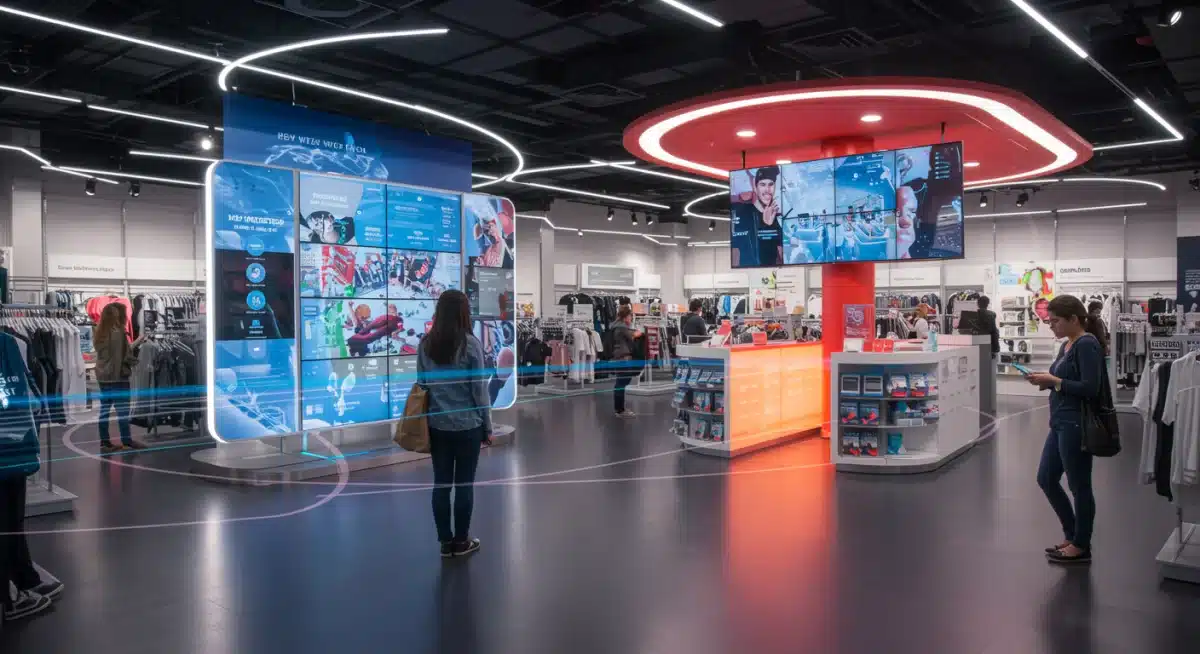
Leveraging AI in retail will boost sales by 15% in 2025 by enabling hyper-personalized customer experiences, optimizing operations, and fostering deeper brand loyalty.
In the rapidly evolving retail landscape, the ability to connect with customers on a deeply individual level is no longer a luxury but a necessity. By 2025, AI retail personalization will be the cornerstone for businesses aiming to significantly boost their sales, with projections indicating a potential 15% increase through tailored customer experiences. This guide explores the transformative power of artificial intelligence in reshaping how retailers understand, engage, and ultimately sell to their audience.
Understanding the AI-Powered Retail Revolution
The retail sector is undergoing a profound transformation, driven largely by advancements in artificial intelligence. This revolution isn’t just about automation; it’s about creating intelligent systems that can learn, adapt, and predict customer behavior with unprecedented accuracy. Retailers who embrace AI are gaining a significant competitive edge, moving beyond generic marketing to deliver truly relevant and timely interactions.
AI’s impact extends across the entire customer journey, from initial product discovery to post-purchase support. By analyzing vast datasets, AI can identify patterns and preferences that human analysts might miss, enabling a level of personalization previously unimaginable. This shift is redefining customer expectations, pushing brands to offer more intuitive and satisfying shopping experiences.
The foundation of AI in retail
At its core, AI in retail relies on sophisticated algorithms and machine learning models to process and interpret data. This data can come from various sources, including online browsing history, purchase records, social media interactions, and even in-store sensor data. The ability to integrate and make sense of these diverse data streams is what empowers AI to drive meaningful personalization.
- Data Collection: Gathering information from every touchpoint.
- Pattern Recognition: Identifying trends and correlations in customer behavior.
- Predictive Analytics: Forecasting future purchasing decisions and preferences.
- Automated Recommendations: Delivering tailored suggestions in real-time.
Ultimately, the AI-powered retail revolution is about creating a symbiotic relationship between technology and human experience. It’s about using machines to augment human capabilities, allowing retailers to focus on strategic growth and customer relationship building while AI handles the complex data analysis and personalized deliveries.
Hyper-Personalization: The New Standard for Customer Engagement
Hyper-personalization takes traditional personalization to the next level, moving beyond segment-based targeting to individual-level recommendations and interactions. In 2025, this will be non-negotiable for retailers looking to capture customer attention and loyalty. AI is the engine behind this shift, enabling brands to understand each customer’s unique preferences, needs, and even emotional state.
Imagine a shopping experience where every product suggestion, every marketing email, and every in-store interaction feels specifically crafted for you. This is the promise of hyper-personalization, and AI is making it a reality. It fosters a sense of being truly understood by a brand, which in turn builds trust and encourages repeat business.
Tailoring the customer journey with AI
AI algorithms analyze individual data points to create dynamic customer profiles. These profiles are continuously updated, ensuring that recommendations remain relevant as customer preferences evolve. This real-time adaptation is critical for maintaining engagement and preventing customer fatigue from irrelevant offers.
- Personalized Product Recommendations: Suggesting items based on past purchases, browsing history, and similar customer profiles.
- Dynamic Pricing: Adjusting prices in real-time based on demand, inventory, and individual customer willingness to pay.
- Customized Marketing Messages: Crafting email campaigns and ads that resonate with specific customer segments or individuals.
The goal is to create a seamless, intuitive, and highly relevant journey for each customer, whether they are shopping online or in a physical store. This level of tailored engagement not only boosts sales but also significantly enhances customer satisfaction and brand loyalty.
Optimizing Operations and Inventory with AI
Beyond customer-facing applications, AI plays a crucial role in streamlining back-end retail operations. Efficient inventory management, demand forecasting, and supply chain optimization are vital for profitability, and AI offers powerful solutions to these complex challenges. By leveraging AI, retailers can reduce waste, cut costs, and ensure products are available when and where customers want them.
The ability of AI to process vast amounts of historical data, market trends, and external factors like weather or economic indicators allows for highly accurate predictions. This predictive power translates into smarter purchasing decisions, reduced stockouts, and minimized overstocking, directly impacting the bottom line.
AI-driven supply chain enhancements
AI algorithms can analyze supplier performance, transportation logistics, and potential disruptions to optimize the entire supply chain. This proactive approach helps retailers mitigate risks and maintain operational continuity, even in the face of unforeseen challenges.
- Demand Forecasting: Predicting future product demand with greater accuracy to optimize inventory levels.
- Automated Reordering: Triggering orders for replenishment based on real-time sales data and forecasts.
- Logistics Optimization: Finding the most efficient routes and methods for product delivery.
Effective operational optimization through AI means that retailers can focus more on strategic growth initiatives and less on day-to-day logistical hurdles. This efficiency directly contributes to a better customer experience by ensuring product availability and timely delivery.
Enhancing the In-Store Experience with AI
While much of the focus on AI in retail often centers on e-commerce, its potential to revolutionize the physical store experience is equally significant. AI can transform brick-and-mortar locations into intelligent, interactive spaces that offer personalized assistance and seamless shopping journeys. This integration bridges the gap between online convenience and the tactile experience of physical retail.
From smart shelves that track inventory in real-time to AI-powered assistants that guide shoppers, in-store AI applications are designed to make shopping more engaging, efficient, and enjoyable. This creates a differentiated experience that online-only retailers cannot replicate, proving that physical stores still hold immense value when augmented by technology.
Smart retail environments
AI-powered sensors and cameras can analyze foot traffic patterns, popular product displays, and even customer emotions to provide valuable insights. This data allows retailers to optimize store layouts, staffing levels, and promotional placements for maximum impact.

- Personalized Guiding: AI-powered apps or smart mirrors offering navigation and product suggestions.
- Queue Management: Optimizing checkout lines to reduce wait times and improve customer flow.
- Interactive Displays: Screens that adapt content based on nearby customer demographics or preferences.
By bringing the intelligence of online personalization into the physical realm, retailers can create a hybrid shopping experience that caters to modern consumer expectations. This seamless integration ensures that customers receive consistent, high-quality engagement across all channels.
Predictive Analytics: Anticipating Customer Needs
One of the most powerful applications of AI in retail is predictive analytics. This capability allows retailers to anticipate what customers will want before they even know it themselves. By analyzing historical data, behavioral patterns, and external market signals, AI can forecast future trends and individual purchasing decisions with remarkable accuracy. This proactive approach is a game-changer for strategic planning and marketing.
Moving from reactive to proactive strategies enables businesses to stay ahead of the curve, offering relevant products and services at precisely the right moment. This not only increases sales but also strengthens customer loyalty by demonstrating a deep understanding of their evolving needs.
Forecasting future trends
Predictive models can identify emerging product categories, shifts in consumer tastes, and seasonal variations with greater precision than traditional methods. This allows retailers to adjust their inventory, marketing campaigns, and even store layouts in anticipation of these changes.
- Churn Prediction: Identifying customers at risk of leaving and implementing retention strategies.
- Next Best Offer: Recommending the most likely product a customer will purchase next.
- Market Trend Analysis: Spotting broader consumer shifts that impact product development and merchandising.
The ability to anticipate customer needs and market dynamics empowers retailers to make data-driven decisions that translate into increased profitability and a stronger market position. Predictive analytics transforms guesswork into strategic foresight.
Challenges and Ethical Considerations in AI Retail
While the benefits of AI in retail are substantial, its implementation is not without challenges and ethical considerations. Data privacy, algorithmic bias, and the need for skilled personnel are critical areas that retailers must address to ensure responsible and effective AI adoption. Ignoring these aspects can lead to customer distrust and regulatory issues, undermining the very advantages AI aims to provide.
Navigating the ethical landscape of AI requires a commitment to transparency, fairness, and consumer protection. Retailers must develop robust data governance policies and invest in technologies that ensure privacy and prevent discriminatory outcomes.
Addressing key concerns
The responsible deployment of AI involves careful planning and continuous monitoring. It’s essential to build AI systems that are not only effective but also equitable and trustworthy.
- Data Privacy: Ensuring compliance with regulations like GDPR and CCPA, and building customer trust through transparent data practices.
- Algorithmic Bias: Developing and auditing AI models to prevent unfair or discriminatory outcomes based on demographics.
- Skilled Workforce: Investing in training and recruiting talent capable of managing and optimizing AI systems.
- Transparency: Clearly communicating to customers how their data is being used for personalization.
By proactively addressing these challenges, retailers can build a foundation of trust with their customers and ensure that AI serves as a force for good, enhancing the shopping experience without compromising ethical principles.
Measuring Success: KPIs for AI-Driven Retail
To truly understand the impact of AI in retail, businesses must establish clear Key Performance Indicators (KPIs) to measure its effectiveness. Simply implementing AI without a robust measurement framework risks failing to realize its full potential. Tracking specific metrics allows retailers to quantify the return on investment (ROI) of their AI initiatives and make data-driven adjustments to optimize performance.
Measuring success goes beyond just sales figures; it includes evaluating improvements in customer satisfaction, operational efficiency, and overall brand perception. A holistic approach to KPIs ensures that AI contributes to long-term sustainable growth.
Key metrics for AI retail success
Different AI applications will have different primary KPIs, but a comprehensive strategy will include a mix of financial, operational, and customer-centric metrics.
- Sales Uplift: Measuring the direct increase in revenue attributable to AI-driven personalization.
- Customer Lifetime Value (CLV): Assessing the long-term value of customers engaged through AI.
- Conversion Rates: Analyzing improvements in the percentage of visitors who make a purchase.
- Inventory Turnover: Evaluating the efficiency of stock movement and reduction in carrying costs.
- Customer Satisfaction (CSAT) Scores: Gauging customer happiness with personalized experiences.
By consistently monitoring these KPIs, retailers can refine their AI strategies, ensuring that their technological investments translate into tangible business outcomes and a competitive advantage in the market.
| Key Aspect | Brief Description |
|---|---|
| Hyper-Personalization | Tailoring customer experiences at an individual level using AI to boost engagement and sales. |
| Operational Efficiency | AI optimizes inventory, supply chain, and logistics, reducing costs and improving product availability. |
| In-Store Enhancements | Transforming physical stores with AI-powered interactive displays and personalized assistance. |
| Predictive Analytics | Anticipating customer needs and market trends to proactively optimize strategies and offerings. |
Frequently Asked Questions About AI in Retail
AI personalizes experiences by analyzing vast amounts of customer data, including browsing history, purchase patterns, and demographics. This allows it to recommend products, tailor marketing messages, and adjust pricing in real-time, creating a unique and relevant shopping journey for each individual customer.
AI significantly enhances retail operations by optimizing inventory management through precise demand forecasting, streamlining supply chain logistics, and automating various back-end processes. This leads to reduced costs, minimized waste, improved efficiency, and better stock availability, ultimately boosting profitability.
Yes, AI can greatly improve the in-store experience. It enables features like smart shelves for real-time inventory tracking, AI-powered digital signage that adapts to customer presence, and personalized in-app navigation. These innovations make physical shopping more engaging, efficient, and tailored to individual preferences, blending online convenience with physical interaction.
Retailers must address critical ethical challenges such as data privacy and security, ensuring compliance with regulations like GDPR and CCPA. They also need to mitigate algorithmic bias to prevent discriminatory outcomes and maintain transparency with customers about data usage. Building trust through responsible AI deployment is paramount for long-term success.
Measuring the ROI of AI investments involves tracking key performance indicators (KPIs) such as sales uplift, customer lifetime value (CLV), conversion rates, and inventory turnover. Additionally, monitoring customer satisfaction scores and operational efficiency improvements can provide a comprehensive view of AI’s impact on a retailer’s profitability and competitive standing.
Conclusion
The journey towards 2025 highlights an undeniable truth: artificial intelligence is no longer an optional upgrade for retailers but a fundamental component for sustained growth and competitive advantage. Leveraging AI in retail: a 2025 guide to boosting sales by 15% through personalized customer experiences is not merely a forecast but a strategic imperative. By embracing AI for hyper-personalization, operational optimization, and predictive insights, retailers can not only meet but exceed evolving customer expectations, fostering deeper loyalty and securing a robust future in a dynamic market. The time to integrate intelligent solutions is now, ensuring that every customer interaction is meaningful and every business decision is data-driven.